
RELEVANT ASPECTS OF THE PHOTON INTERACTIONS WITH MATTER
Photons can interact in different ways depending on their energy (Evans, 1955; Jauch and Rohrlich; 1976; Agarwal, 1991). The photons in the x-ray regime interact with the electron shells which surround the nucleus. The nucleus itself does not contribute to the scattering or absorption of photons.
The interaction of a photon of energy
 with an isolated atom A has the effect of changing the atom's state from
 to
to
 , which can be expressed as
 (1)
(1)
Eqn (1) denote the type of photon-atom interactions of interest in this work, having one initial photon and only one resulting photon.
 denotes the atom plus all the non-photonic particles produced in the reaction.
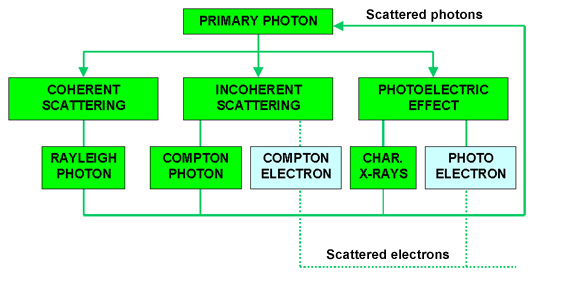
There are three photon-atom processes whose influence prevail in the x-ray regime: the photoelectric effect in which the photons cause the ejection of an electron leaving a hole in the atom which, when the vacancy is filled by another electron, emits a fluorescence photon having the energy difference between the electron and the hole levels; the unmodified or Rayleigh scattering in which the photon changes momentum but not energy; and the modified or Compton scattering in which both momentum and energy are transferred to the electrons comprising the atom.
What we call an interaction may not be strictly a single process. Any sequence of physical processes in rapid succession, originated by a photon and producing another(other) photon(s), can be statistically considered as an unique interaction, as occurring for example with the photoelectric effect.
The resulting (or secondary) photon from the interactions may collide in turn with another atom, starting a multiple chain of events that we want to study. However, not only photons are produced in the photon-atom interactions. The photoelectric effect and the modified scattering produce electrons which, obeying other kind of interactions, can produce new photons. Since these contributions render the transport problem far more complicated because of the coupling between photons and electrons, we shall neglect in this work bremsstrahlung (braking radiation) of the Compton and photoelectric electrons, and also other photon sources such as anomalous scattering and pair production-annihilation.
 |
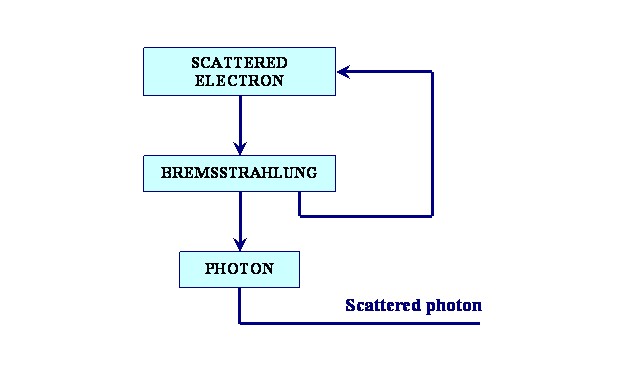 |
Figure 1. Main mechanisms of photon and electron scattering in the x-ray regime. Scattered electrons feedback new photons into the photon interactions cycle, and, therefore, the full transport problem should be solved with two coupled systems of transport equations, one for polarised photons and one for polarised electrons. The photon transport equation, which neglects the electron interactions, is an excellent approximation when the probability for bremsstrahlung is low.
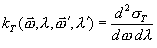
The single-process kernels play a very important role in transport theory. They represent the probability density -by unit wavelength, by unit solid angle, and by unit path- that the process may change the phase-space variables from
 to
to
 . Therefore a kernel is directly related to the double-differential scattering coefficient of the interaction, i.e.
 (2)
(2)
Thus, the scattering coefficient for the process T can be obtained from
 (3)
(3)
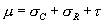
allowing the comparison with experimental or theoretical data. The photon cross sections for the interaction processes of interest constitute the main part of the total attenuation coefficient (McMaster et al., 1969; Storm and Israel, 1970; Veigele, 1973; Hubbell et al., 1986; Saloman et al., 1988; Cullen et al., 1989; Hubbell, 1999), so we can define the total attenuation coefficient
 as:
as:
 (4)
(4)
where
 and
and
 are the Compton (incoherent) and Rayleigh (coherent) integral attenuation coefficients and
 is the photoelectric attenuation coefficient.
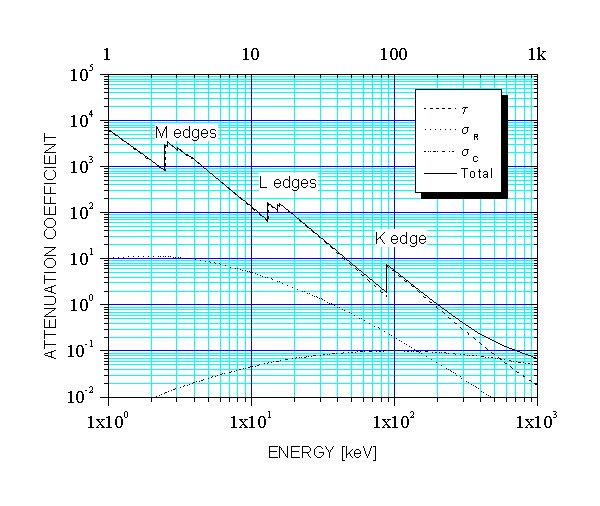 |
Figure 2. Plot of the total attenuation coefficient of Pb showing the contribution of the photoelectric, Rayleigh and Compton attenuation coefficients. Data from McMaster et al (1969).
If we consider the attenuation of photons, then at low energies the atomic photoelectric effect predominates, while at intermediate energies Compton scattering dominates. If, however, we are concerned with the scattering of photons, then Rayleigh scattering dominates at low energies or forward angles, while Compton scattering dominates at higher energies or larger angles. In what follows we shall give the atomic interaction kernels for the three dominating processes that participate in x-ray photon transport. As a first approximation we shall use the coherent and incoherent scattering factor approximation to describe scattering cross-sections. The scattering factor approximation assume a smooth behaviour to the scattering cross-sections so they cannot explain scattering resonances (Kissel and Pratt, 1987) such as anomalous scattering (Kane at al., 1986; Bui and Milazzo, 1989). The effect of the relative motion of the electrons with respect to the incident photon beam will be considered later. The relative motion of the electrons does not have a significant effect on the coherent scattering. However, at least for the incoherent case, the scattering factor can be obtained with an integration of momentum profiles of single orbitals (Ribberfors and Berggren, 1982) giving a simple connection between the Compton profiles and the corresponding scattering factor. Polarisation effects will be also considered, and will be discussed separately for every scattering process.
The photoelectric effect is an indirect photon-photon process. In the photoelectric effect a photon is absorbed by an atom creating a hole in the atom with the ejection of an electron. The energy of this electron is the difference between that of the incident photon and of the binding energy of the electron. The vacancy will be spontaneously filled by means of an electron transition from a higher energy level. The de-excitation energy is carried off with the emission of a characteristic photon or Auger electrons. Statistically, the two combined processes (absorption/ejection) may be considered as a single interaction. The theory of the photoionisation process has received great attention (e.g. Fano and Cooper, 1968; Starace, 1982; Amusia, 1990), the photoelectric cross-section has been largely investigated with experiments and theoretical calculations (Scofield, 1987), and collected data are available elsewhere (Scofield, 1973; Saloman et al., 1988).
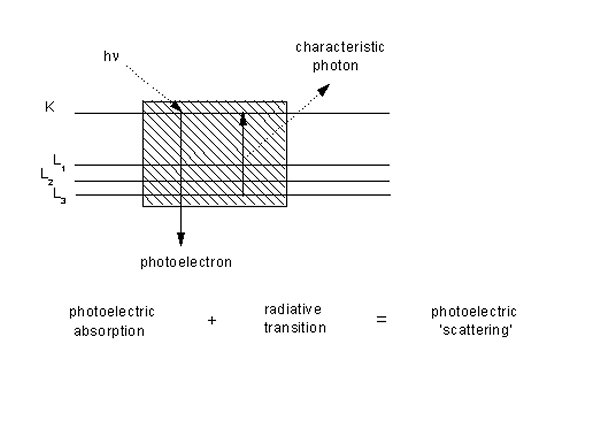 |
Figure 3. A photoelectric absorption followed by a radiative transition to the created vacancy can be thought as photoelectric 'scattering' giving one characteristic photon and one photoelectron, because of the short time interval between these two processes.
The scalar kernel for the production of a characteristic line of wavelength
 [see the classic work of Bearden (1967) for x-ray wavelengths; a more recent survey of x-ray energies has been done by Deslattes et al. (1997)] from a pure element target due to the photoelectric absorption of photons with wavelength
 (Fernández, 1989) is given by:
 (5)
(5)
The isotropy of the secondary x-rays is reflected by the kernel independence on
 and by the
 normalisation factor. The line is assumed to be monochromatic, neglecting its natural width (Krause and Oliver, 1979) which is significantly less than the instrumental width (Salem et al., 1977). The XRF emission probability density
 for a line
 which belongs to the K-series, is given (in cm-1) by the relation:
 (6)
(6)
where
 denotes the radiative fraction for a given series of transitions. The fraction of vacancies produced in the K subshell will be filled with transitions from other higher shells giving
 (7)
(7)
The allowed transitions to a subshell can be either radiative or radiationless. Radiative transitions clearly lead to a characteristic line emission. Radiationless transitions, on the contrary, can be of two types: Auger and Coster-Kronig. The Auger effect is produced when the x-ray photon originated in the transition is absorbed by an outer electron of the atom, which is subsequently ejected. Therefore, the Auger electron ejection produces a doubly ionised atom, without photon emission. On the other side, Coster-Kronig transitions produce transitions within subshells of the same shell. This makes possible that a given subshell can receive contributions coming from different higher subshells to produce the same group of lines. This brings to more complex probabilities for the emission of L1, L2 or L3 lines, which for
 are given by
 (8)
(8)
 (9)
(9)
 (10)
(10)
where
 ,
,
 and
and
 are, respectively, the probabilities for the occurrence of the Coster-Kronig radiationless transitions
 ,
,
 and
and
 (Fink et al., 1966; Bambynek et al., 1972; Salem et al., 1974; Krause, 1979; Langenberg and Van Eck, 1979; Cohen, 1987; Hubbell, 1989; Singh et al., 1990; Puri et al., 1993a, 1993b; Hubbell et al., 1994).
 |
Figure 4. Scheme describing Auger and Coster-Kronig transitions compared with radiative transitions.
In Eqn (6),
 represents the photoelectric attenuation coefficient (cm-1) of the emitter element s for the corresponding subshell,
 represents the absorption-edge jump (McMaster et al., 1969; Scofield, 1973; Saloman et al., 1988; Cullen et al., 1989),
 the fluorescence yield of the subshell, and
 the line emission probability of the line at
 into its own spectral series (Scofield, 1969, 1974, 1975; Hansen et al., 1970; Khan and Karimi, 1980). For compilations of calculated values of
 for neutral atoms with a relativistic Hartree-Slater model (renormalised to the Hartree-Fock model for Z=2-54) see Hubbell and co-workers (Hubbell et al., 1974, 1980; Hubbell, 1982), and (without renormalization) Scofield (1973), Saloman et al. (1988), Cullen et al. (1989, 1997) and Trubey et al. (1989); for a discussion about the significance of the normalisation see Saloman and Hubbell (1987). The line is emitted only when
 is lower than the threshold of the absorption edge wavelength
 (Bearden and Burr, 1967; Cullen et al., 1989) of the series to which the line belongs, as represented by the Heaviside function
 in equation (5).
 |
Figure 5. Nomenclature of x-ray transitions.
The complete emission spectrum of the element s is obtained adding all the single lines emitted by absorption of radiation of wavelength
 :
:
 (11)
(11)
It is worth noting that the integral (3) of the kernel defined by Eqn (11) cannot give the photoelectric coefficient
 . The reason is that the attenuation coefficient is formed by both, an absorption part and a scattering part (the 'scattering' here is represented by the spontaneous emission of characteristic photons). The emission does not compensate exactly the absorption, because every absorbed photon does not produce a characteristic photon. Therefore, an integral over all the characteristic photons cannot return the number of the absorbed ones.
The matrix version of the photoelectric kernel for the vector equation
The photoelectric effect has low sensitivity to the polarisation of the incident photon but is not completely insensitive to it. According to Flügge et al. (1972), after photoionisation, the fluorescence x-rays originating from the vacancy states with j=1/2, (K shell and L1, L2, M1 and M2 subshells, etc.) will only be isotropic and unpolarised. However those fluorescence x-rays which are emitted from the filling of vacancy states with j=3/2 (L3, M3, and M4 subshells) and with j=5/2, (M5 subshell) will be anisotropic and polarised. This theoretical prediction was recently confirmed experimentally by Kahlon et al. (1991) supporting the hypothesis that the vacancy states with j>1/2 have a non-statistical population distribution of their magnetic substates and are aligned. The level of percentage polarisation measured by these authors for the
 and
and
 lines was 86(6)% and 29(2)% for Th, and 79(6)% and 36(2)% for U. However, more recent measurements on the L3 subshell x-ray lines of Erbium by Papp and Campbell (1992) reveal a considerably less consistent anisotropy than the reported by Kahlon et al. (1991), and estimate the anisotropy for the
 doublet (containing about the 80% of the L3 x-rays) in less that 2%. It is worth nothing that this controversy does not affect the existence of the non-statistical population distribution or otherwise mentioned above, but only the extent of the anisotropy that in the latter case could be negligible. Recently, Papp (1998) has explained the apparently lower contribution they measured as the consequence of a resultant state produced by the overlap of two opposite polarisation states (where the single polarisation states of the lines become hidden in the measurement). This hypothesis opens again the interest in investigating the polarisation dependence of characteristic lines, since it could change appreciably the detectability of such lines under specially designed experimental set-ups.
Assuming that photoelectric x-ray emission is independent of polarisation, we can write the matrix kernel for the emission of a characteristic line of wavelength
 as:
as:
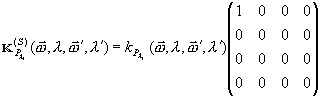 (12)
(12)
where the scalar kernel was defined in equation (5). The complete emission spectrum can be obtained similarly as in equation (11).
 |
Coherent scattering is a process where the photons change direction (momentum transfer) but not energy (Kane et al., 1986). This scattering takes place with the more tightly bound electrons of the atom which behave rigidly during the interaction. In a first approximation the coherent scattering by a free electron was studied by J.J. Thomson using classical electrodynamics (Agarwal, 1991)
 (13)
(13)
where
 is the classical radius of the electron. The delta function stresses the monochromaticity of the scattering. In many electron atoms, a cooperative effect is verified by the scattering from all the electrons in the atom (Rayleigh scattering). Since the scattering is coherent, the amplitudes must be added before squaring to obtain the intensity. Therefore, the cross-section for electron results non-additive, and we have to define an atomic differential cross-section as
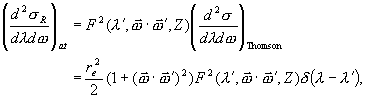 (14)
(14)
The square form factor
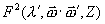 can produce atomic contributions significantly greater than Z times the contribution from one single electron. In terms of the transferred momentum
 , the form factor for an atom of Z electrons has been defined as the matrix element (Nelms and Oppenheim, 1955)
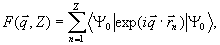 (15)
(15)
where
 denotes the instantaneous position of the n-th electron, respectively, and
 the ground-state wave function. Hubbell at al. (1975) have reviewed exhaustively the computation of the form factor. By defining the transferred momentum as
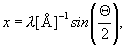 (16)
(16)
for given wavelength and scattering angle, they computed tables of
 for all the elements in the periodic table. Experimental data and other tables may be found in more recent works (Hubbell and Øverbø, 1979; Schaupp et al., 1983; Kane et al., 1986). Some special limits of the form factor are
 and
and
 . The Rayleigh atomic kernel for unpolarised photons, with phase-space coordinates
 scattered by a pure element target of atomic number Z into the coordinates
 is defined as
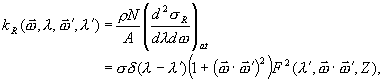 (17)
(17)
where
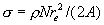 is a macroscopic attenuation coefficient (in [cm-1]). The angular dependence of the kernel (17) is due to the last two factors: the Thomson angular factor representing an average polarisation state, and the square of the atomic form factor comprising the constructive interference from the whole charge distribution.
A simple approximation for F was given by Veigele et al. (1966) using the Thomas-Fermi model
 (18)
(18)
with
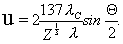 (19)
(19)
More precise values are achieved with semi-empirical formulae and fitting coefficients of theoretical calculations (Cromer and Waber, 1965; 1974), or interpolating values in the Hubbell's tables in the ENDF-6 data file (Cullen at al., 1989; Rose and Dumford, 1990, Cullen et al., 1997). Recently, Cullen (1995) has developed a fitting tool to compute fitting coefficients for user defined fitting functions of different complexities for the form factor, using the ENDF-6 file. The integration of the scalar kernel (17) giving the total Rayleigh coefficient can be used for checking the form factor data consistency. Values for the integrals are available, either from numerical integration (McMaster et al., 1969; Hubbell et al., 1975), or from the analytical integration of the approximated form factor (Hanson, 1985).
 |
Figure 6. Plots of form factors for several elements. Data from Cromer and Waber (1974).
The matrix version of the Rayleigh kernel for the vector equation
Assuming that electron binding (in many electron atoms) can be described by a polarisation independent form factor (Brown and Mayers, 1956, 1957; Kane et al., 1986), the matrix kernel for Rayleigh scattering of polarised radiation becomes:
 (20)
(20)
|
In incoherent scattering, energy as well as direction is changed (Compton, 1923; Evans, 1958). This process takes place with the outer electrons of the atom. In a first approximation the Compton effect can be studied by considering the collision of one photon carrying energy
 , momentum
 and travelling with direction
 , against a free electron at rest (mass rest energy
 , null momentum). Conservation of energy and momentum during the hit establishes that, if the photon scatters with a scattering angle
 , it carries a wavelength
 . Here
 , and
, and
 =0.0242631Å is the Compton wavelength. The validity of this approximation is considered as a proof of the particle nature of the photon. In agreement with the approximation, scattering experiments for a narrowly defined scattering angle show a well defined peak at a wavelength higher than the incident one. Klein and Nishina (1929) (see also Heitler, 1935) computed the differential electronic cross section for the described collision (average polarisation):
 (21)
(21)
where
 (22)
(22)
The direction-wavelength delta in equation (15) fixes the integration path in the phase-space along the line
 [this condition does not account for the shift for bound electrons (Evans, 1958)].
The Compton kernel in the Waller-Hartree approximation
When the energy of the exciting photons is comparable with the binding energy of the inner-shell electrons of the target, a departure from the Klein-Nishina cross section is verified. It is customary to define the Waller-Hartree incoherent scattering function
 which takes into account the electron binding for the whole atom (Waller and Hartree, 1929),
 (23)
(23)
where
 denotes the transferred momentum during the collision,
 and
and
 the instantaneous position of the m-th and n-th electrons, respectively, and
 the ground-state wave function. Hubbell at al. (1975) reviewed exhaustively the computational techniques for obtaining the scattering function. By defining the transferred momentum as in Eqn (16), they computed tables of
 for all the elements in the periodic table. Special limits of the scattering function are
 and
and
 . The double differential atomic cross-section for incident photons, with phase-space coordinates
 scattered by a pure specie target of atomic number Z into the coordinates
 , is expressed as
 (24)
(24)
Therefore, the Compton kernel is
 (25)
(25)
A simple formula for
 was obtained with the Thomas-Fermi model by Veigele et al. (1966)
 (26)
(26)
with
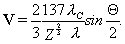 (27)
(27)
More precise values of
 can be computed using semi-empirical formulas and fitting coefficients to theoretical calculations (Smith et al., 1975), or interpolating values in the Hubbell's tables in the ENDF-6 data file (Cullen at al., 1989; Rose and Dumford, 1990, Cullen et al., 1997). Recently, Cullen (1995) has developed a fitting tool to compute fitting coefficients for user defined fitting functions of different complexities for the scattering function, using the ENDF-6 file.
 |
Figure 7. Plots of scattering functions for several elements. Data from Smith et al (1975).
The Compton kernel in the impulse approximation
The pre-collision motion of the electrons has been ignored in the kernel equation (25), limiting the Compton peak to a monochromatic line. Because of the Compton profile (that is the projection of the electron momentum distribution on the z-axis) the width of the scattered peak is larger than the instrumental width (Cooper, 1985). The more rigorous theoretical treatment associated with the Compton profile will be discussed in this section.
If we define as
 the projection of the momentum of the interacting electron on the scattering vector
 (
(
 and
and
 being the momenta of the incident and scattered photons), then it can be demonstrated that the Compton shift produced by a moving electron is also a function of

 (28)
(28)
It is customary to use the dimensionless variable Q (Biggs et al., 1975) defined as
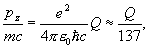 (29)
(29)
in place of
 in Eqn (28). However, a bound electron in the atom do not hold a definite state of momentum like the shown in Eqn (28), but has a momentum distribution that depends on the sub-shell occupied by the electron. If we denote with an index i the sub-shell occupied by the electron, the Compton profile is related to the momentum distribution
 of the scatterer before the collision through the relationship
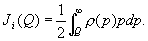 (30)
(30)
As a consequence of wave-function normalisation, the integrated profile must satisfy the condition
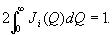 (31)
(31)
To deduce the Compton intensity in the Impulse Approximation we use the relations
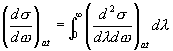 (32)
(32)
and
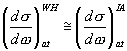 (33)
(33)
implying that the scattering function should be equivalent in both representations (Ribberfors and Berggren, 1982)
 (34)
(34)
From Eqns (25), and (32)-(34) we obtain
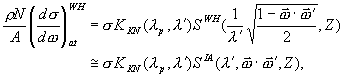 (35)
(35)
where
 is the peak wavelength. Since the scattering function for the atom (in the Impulse Approximation) is obtained as a sum of the contributions from all the sub-shells, we have
 (36)
(36)
where
 is obtained by putting
 (Ii being the binding energy of the sub-shell) in the expression
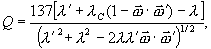 (37)
(37)
which is obtained straightforwardly from Eqn (28). The integral in the rhs of Eqn (36) represents the contribution of one electron in the sub-shell i to the scattering function. Being such a contribution upper-limited by
 , it is equivalent to integrate with a higher upper limit the sub-shell profile truncated at
 , i.e.
 (38)
(38)
The sum over the occupied states in the rhs of Eqn (36) can be shifted into the integral. In this way we can define the whole profile at
 ,
,
 and Z as the overlap of the truncated profiles of the Z electrons of the element, i.e.
 (39)
(39)
 |
 |
Figure 14. (a) Contributes of the configuration electrons to the Compton profile of Zr. (b) Compton profiles for several elements. In this example the excitation energy is 150 keV, and the scattering angle is 60o. Data from Biggs et al (1975).
Eqn (36) can be rewritten by making a change of variable in the integral
 (40)
(40)
From Eqns (28), (35) and (40) we can write the IA equivalent of Eqn (25)
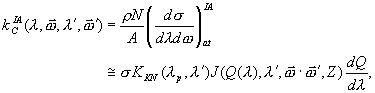 (41)
(41)
where
 (42)
(42)
is obtained from Eqn (37). Eqn (41) represents the alternative to Eqn (25) using Compton profiles. Since the broadening of the Compton peak is considerably large, the IA gives a much more precise estimate of the intensity distribution of the Compton peak, specially in relation with spectrum build-up in the x-ray regime.
The matrix version of the Compton kernel for the vector equation
A Klein-Nishina coefficient for linear polarisation could be written in place of the coefficient defined in Eqn (22) (Nishina, 1929; Evans, 1958; Stroscio, 1984), which depends on the angle between the directions of the electric vectors of the incident (
 ) and scattered (
 ) beams. It shows the familiar relationship:
 (43)
(43)
The above statement means that the scattering cross section determines the probability for a plane polarised photon to be scattered in a certain direction and then to pass through a hypothetical filter which accepts only radiation polarised in a certain plane. Elliptical polarisation is not considered by such a treatment. Therefore, for a complete analysis of the polarisation effects it is more convenient to use the Stokes' representation.
Assuming that the effect of charge distribution (in many electron atoms) contributes a polarisation independent scattering function and the spin of the electron is randomly oriented before, and is not observed after the scattering (Fano et al., 1959), the matrix kernel for Compton scattering becomes:
 (44)
(44)
where we used the dimensionless variables
 , and
, and
 . In the limit case of
 , we obtain the matrix of Rayleigh scattering.
For studying the effects of non-linear polarisation on the scattering of x-rays in a target exposed to a magnetic field is useful to consider a more complete kernel including the magnetic terms omitted in equation (44). This matrix kernel can be obtained in a first approximation by considering Compton scattering by a free electron exposed to an external magnetic field, becomes (Fano, 1949):
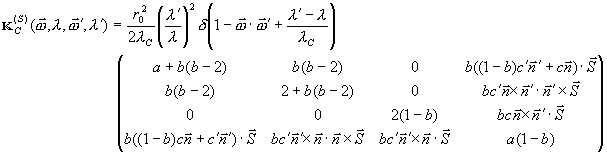 (45)
(45)
where
 and
and
 are auxiliary variables,
 and
and
 are the directions of the scattered and incident photons, and
 is the spin orientation of the electron before the scattering. It is apparent that some new non-zero terms appear in the last row and column of the matrix. They are due to a specific rather than an average orientation for the spin of the electron. These terms introduce coupling for the last Stokes' component of the flux, responsible of the ellipticity, i.e. of the non-linearity of the polarisation state. It is this coupling that avoids consideration of the transport equation corresponding for the V component as a separate, uncoupled equation, as for the case of linear polarisation.
Several authors have paid attention to the build-up of a much more detailed description of the differential cross section, depending on the initial and final polarisation states of both interacting photon and electron (see Franz, 1936, 1938; Fano, 1949; Lipps and Tolhoek, 1954a, b; Tolhoek, 1956; Olsen, 1968; Ewald and Franz, 1976), but this extent of detail is excessive for the scope of this paper.
In order to extend the kernel (45) to atoms with many electrons (Platzman and Tzoar, 1970, 1985), we must consider the distribution of the magnetisation in addition to that of the electric charge. Therefore, the matrix kernel becomes more complex than the kernel (44) that was obtained in absence of the magnetic field. This feature makes that the complete matrix kernel is composed of the sum of two matrix terms, one depending on the electric charge distribution, as in equation (44), and another one depending on the magnetisation distribution. For the last distribution it is convenient to define a magnetic form factor which, in analogy to the charge form factor, can be expressed [in agreement with the definition of Collins et al. (1990, 1992)] as the modulus of the spatial Fourier transform of the spin density:
 (46)
(46)
where
 and
and
 are the spin and position of the electron labelled j,
 is the spin density,
 the Bohr magneton, and
 is the momentum transfer. Since the magnetisation density is more diffuse spatially than the charge density, the magnetic form factor falls off more rapidly than the charge form factor.
Equation (45) does not include the orbital magnetisation, which was considered in detail (Blume, 1985; Blume and Gibbs, 1988; Gibbs et al., 1985, 1989) for x-ray diffraction. The orbital magnetisation should be considered to get a formal picture of the magnetic properties of the atom with respect to the polarised radiation. Recently, this feature has given rise to speculation that Compton scattering might be used for separating the magnetisation densities of the spin and orbital magnetisation (Collins et al., 1990). However, in more recent studies, Cooper et al. (1992) and Timms et al. (1993) have found that the orbital magnetisation term is negligible at the Compton limit of high-energy photon scattering, while it maintains a central importance for Bragg diffraction. For this reason, we can, by the moment, omit the orbital magnetisation to obtain a simplified expression of the complete matrix kernel for the Compton effect:
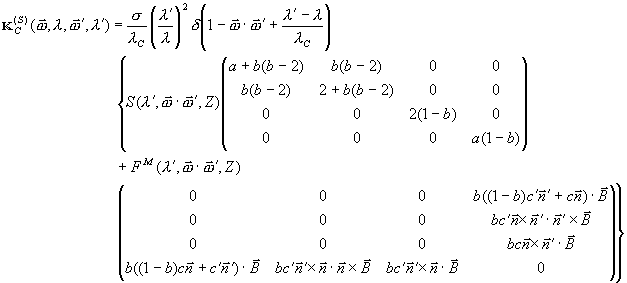 (47)
(47)
where
 is a unitary vector oriented in the direction of the external magnetic field, and
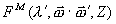 is the magnetic form factor expressed as a function of the wavelength and scattering angle instead of the transferred momentum. From Eqn (47) it is easy to see that the ratio of the magnetic scattering intensity term related to the usual charge intensity term, is proportional to:
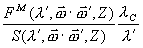 (48)
(48)
The factor
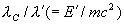 is small (~10-2) under 50 keV and this makes the magnetic signal still weak compared to the electric one.
|
References
Agarwal BK (1991) X-ray spectroscopy 2nd Ed. Springer-Verlag, Berlin.
Amusia MYa (1990) Atomic Photoeffect Plenum Press, New York.
Bambynek W, Craseman B, Fink RW, Freund HU, Mark H, Swift CD, Price RE and Venugopala Rao P (1972) X-Ray Fluorescence Yields, Auger, and Coster-Kronig Transition Probabilities. Rev. Mod. Phys.44, 716-813.
Bearden JA (1967) X-ray wavelengths. Rev. Mod. Phys.39, 78-124.
Bearden JA, Burr F (1967) Reevaluation of X-ray atomic energy levels. Rev. Mod. Phys.39, 125-142.
Biggs F, Mendelsohn LB and Mann JB (1975) Hartree-Fock Compton profiles for the elements.At. Data Nucl. Data Tables16, 201.
Blume M (1985) Magnetic scattering of x rays. J. Appl. Phys.57, 3615-3618.
Blume M and Gibbs D (1988) Polarization dependence of magnetic X-ray scattering. Phys.Rev. B3, 1779-1789
Brown GE and Mayers DF (1956) The Coherent Scattering of Gamma-Rays by K Electrons in Heavy Atoms. III. The Scattering of 0.64 mc Gamma-Rays in Mercury. Proc. Roy. Soc. LondonA234, 387.
Brown GE and Mayers DF (1957) The Coherent Scattering of Gamma-Rays by K Electrons in Heavy Atoms. IV. The Scattering of 1.28 and 2.56 mc Gamma-Rays in Mercury. Proc. Roy. Soc. LondonA242, 89.
Bui C and Milazzo M (1989) Measurements of anomalous dispersion in Rayleigh scattering of characteristic X-ray fluorescence. N. CimentoD11, 655.
Chandrasekhar S (1950) Radiative Transfer Clarendon Press, Oxford [(1960) Reprinted with corrections by Dover, New York]. Ch.1 (The Equations of Transfer), particularly Sec. 15 (The Representation of Polarised Light).Cohen DD (1987) Average L shell fluorescence yields. Nucl. Intrum. MethodsB22, 55.
Collins SP, Cooper MJ, Lovesey SW and Laundy D (1990) Spin and orbital magnetisation densities determined by Compton scattering of photons. J. Phys.: Condens. Matter2, 6439-6449.
Collins SP, Laundy D and Rollason AJ (1992) Magnetic form factors of ferromagnetic iron by X-ray diffraction. Phil. Mag.B65, 37-46.
Compton AH (1923) A quantum theory of the scattering of X-rays by light elements. Phys. Rev.21, 483.
Cooper MJ (1985) Compton scattering and electron momentum determination. Rep. Prog. Phys.48, 415-481.
Cooper MJ, Zukowski E, Collins SP, Timms DN, Itoh F and Sakurai H (1992) Does magnetic Compton scattering only measure spin magnetization? J. Phys.: Condens. Matter 4, L399.
Cromer DT and Waber JT (1965) Scattering factors Computed from Relativistic Dirac-Slater Wave Functions, Acta Cryst.18, 104-109.
Cromer DT and Waber JT (1974) Atomic scattering factors for X-rays. In: International Tables for X-Ray Crystallography, JA Ibers, WC Hamilton, eds., Vol. 4, Kynoch Press, Birmingham, pp. 71-147.
Cullen DE (1995) A simple model of photon transport. Nucl. Instr. Meth. Phys. Res. B101, 499-510.
Cullen DE, Chen MH, Hubbell JH, Perkins ST, Plechaty EF, Rathkopf JA and Scofield JH (1989) Tables and Graphs of Photon-Interaction Cross Sections from 10 eV to 100 GeV Derived from the LLNL Evaluated Photon Data Library (EPDL), Lawrence Livermore National Laboratory Report UCRL-5400, Vol. 6, Parts A and B, Rev. 4.
Cullen DE, Hubbell JH and Kyssel L (1997) EPDL97: the Evaluated Photon Data Library, ’97 version. UCRL-50400,Vol. 6, Rev. 5.
Deslattes RD, Kessler EG Jr., Indelicato P and Lindroth E (1997) X-ray transition energies: new approach and comprehensive evaluation. (unpublished)
Evans RD (1955) The atomic nucleus McGraw-Hill, New York.
Evans RD (1958) Compton effect. In Handbuch der Physik, Vol XXXIV, p. 218. Springer, Berlin.
Ewald H and Franz W (1976) Scattering of a Polarized Photon by a Polarized Electron. Z. Naturforsch.A31, 808-814.
Fano U (1949) Remarks on the Classical and Quantum-Mechanical Treatment of Partial Polarization. J. Opt. Soc. Am.39, 859-863.
Fano U, Spencer LV and Berger MJ (1959) Penetration and diffusion of X-rays. In Encyclopedia of Physics, Vol 38/2, p. 660. Springer Verlag, Berlin.
Fano U and Cooper JW (1968) Spectral distribution of atomic oscillator strengths. Rev. Mod. Phys.40, 441.
Fernández JE (1989) XRF intensity in the frame of the transport theory. X-Ray Spectrom.18, 271-279.
Fernández JE (1995) Polarisation effects and gamma transport. Appl.Rad Isot.46, 383-400.
Fernández JE (1998) Non-linear effects in polarised photon transport. Appl.Rad Isot.49, 83.
Fernández JE and Molinari VG (1990) Theoretical estimation of the fourth-order XRF intensity. Adv. X-Ray Anal.33, 573-580.
Fernández JE and Molinari VG (1991) X-Ray Photon spectroscopy calculations. In: Advances in Nuclear Science and Technology, Vol. 22, J Lewins, M Becker eds., Plenum Press, New York, pp. 45-104.
Fernández JE, Hubbell JH, Hanson AL and Spencer LV (1993) Polarization effects on multiple scattering gamma transport. Rad. Phys. Chem.41, 579-630.
Fink RW, Jopson RC, Mark H and Swift CD (1966) Atomic fluorescence yields. Rev. Mod. Phys.38, 513.
Flügge S, Mehlhorn W and Schmidt V (1972) Angular distribution of Auger electrons following photoionization. Phys. Rev. Lett.29, 7-9
Franz W (1936) Rayleighsche Streuung harter Strahlung an schweren Atomen, Z. Physik98, 314.
Franz W (1938) Die Streuung von Strahlung am magnetischen Elektron. Ann. Physik33, 689-707.
Gibbs D, Moncton DE and D'Amico KL (1985) Magnetic x-ray scattering studies of the rare-earth metal holmium. J. Appl. Phys.57, 3619-3622.
Gibbs D, Blume M, Harshman DR and McWhan DB (1989) Polarization Analysis of Magnetic X-Ray Scattering. Rev. Sci. Instr.60, 1655-1660.
Hansen JS, Freund HU and Fink RW (1970) Radiative X-ray transition probabilities to the K-shell. Nucl. Phys.A142, 604.
Hanson AL (1985) An Analytical Solution to the Rayleigh Scattering Cross Section Integral. Nucl. Instrum. MethodsA234, 552.
Heitler W (1935) The quanrum theory of radiation, Clarendon Press, Oxford.
Hubbell JH (1982) Photon Mass Attenuation and Energy Absorption Coefficients from 1 keV to 20 MeV. Int. J. Appl. Rad. Isot.33, 1269.
Hubbell JH (1989) Bibliography and current status of K, L, and higher shell fluorescence yields for computation of photon energy-absorption coefficients, National Institute of Standards and Technology Report NISTIR 89-4144.
Hubbell JH (1999) Review of photon interaction cross section data in the medical and biological context, Phys. Med. Biol.44, R1-R22.
Hubbell JH and Øverbø I (1979) Relativistic atomic form factors and photon coherent scattering cross-sections. J. Phys. Chem. Ref. Data8, 69.
Hubbell JH, Gerstemberg HM and Saloman EB (1986) Bibliography of photon total cross-sections (attenuation coeffcients) measurements 10 eV to 13.5 GeV. National Bureau of Standards Report NBSIR 86-3461.
Hubbell JH, Gimm HA and Øverbø I (1980) Pair, Triplet, and Total Atomic Cross Sections (and Mass Attenuation Coefficients) for 1 MeV - 100 GeV Photons for Elements Z = 1 to 100. J. Phys. Chem. Ref. Data9, 1023.
Hubbell JH, McMaster WH, Kerr del Grande N and Mallett JH (1974) X-ray cross-sections and attenuation coefficients. In International Tables for X-Ray Crystallography, Vol 4, p. 47. Kynoch Press, Birmingham.
Hubbell JH, Trehan PN, Singh Nirmal, Chand B, Metha D, Garg ML, Garg RR, Singh Surinder, Puri S (1994) A review, Bibliography, and Tabulation of K, L, and Higher Atomic Shell X-Ray Fluorescence Yields, J. Phys. Chem. Ref. Data23, 339-364.
Hubbell JH, Veigele WmJ, Briggs EA, Brown RT, Cromer DT and Howerton RJ (1975) Atomic form factors, incoherent scattering functions, and photon scattering cross sections. J. Phys. Chem. Ref. Data 4, 471-538.
Janssens K, Vincze L, Van Espen P, Adams F (1993) Monte Carlo simulation of conventional and synchrotron energy-dispersive X-ray spectrometers. X-Ray Spectrom.22, 234-243.
Jauch JM and Rohrlich F (1976) The theory of photons and electrons Springer-Verlag, Berlin.
Kahlon KS, Aulakh HS, Singh N, Mittal R, Allawadhi KL, Sood BS (1991) Measurement of angular distribution and polarization of photon-induced fluorescent X-rays in Thorium and Uranium. Phys. Rev.A43, 1455-1460.
Khan MR and Karimi M (1980) Kb/Ka ratios in energy dispersive X-ray emission analysis. X-Ray Spectrom.9, 32.
Kane PP, Kissel L, Pratt RH and Roy SC (1986) Elastic scattering of g-rays and X-rays by atoms. Phys. Rep.140, 75.
Kissel L and Pratt RH (1987) Status of cross-sections data for photon scattering of atoms, Trans. Am. Nucl. Soc.55, 199-200 (1987).
Klein O and Nishina Y (1929) Tber die streuung von strahlung durch freie elektronen nach der neuen relativistischen quantendynamik von Dirac. Z. Phys.52, 853.
Krause MO (1979) Atomic Radiative and Radiationless Yields for K and L Shells, J. Phys. Chem. Ref. Data8, 307-327.
Krause MO and Oliver JH (1979) Natural widths of atomic K and L levels, Ka X-Ray lines and several KLL Auger lines. J. Phys. Chem. Ref. Data8, 329-338.
Langenberg A and Van Eck J (1979) An evaluation of K-shell fluorescence yields; observation of outer-shell effects. J. Phys.B12, 1331.
Latishev AV (1995) The Riemann-Hilbert vector boundary-value problem for the scattering of polarised light. Comp. Maths Math. Phys.35, 885-900.
Lipps FW and Tolhoek HA (1954a) Polarization phenomena of electrons and photons. I. General method and applications to Compton scattering. Physica20, 85-98.
Lipps FW and Tolhoek HA (1954b) Polarization phenomena of electrons and photons. II. Results for Compton scattering. Physica20, 395-405.
McMaster WH, Kerr del Grande N, Mallett JH, Hubbell JH (1969) Compilation of X-ray cross-sections, Lawrence Livermore National Laboratory Report UCRL-50174, Sect. 2, Rev. 1.
Namito Y, Ban S and Hirayama H (1993) Implementation of linearly-polarized photon scattering into the EGS4 code. Nucl. Instr. Meth. Phys. Res.A332, 277-283.
Nelms AT and Oppenheim L (1955) J. Res. Nat. Bur. Stand.55, 53-62.
Olsen H (1968) Ch. 4: Polarization Effects in Scattering and Radiation Processes. In Applications of Quantum Electrodynamics, Springer Tracts in Modern Physics, Vol. 44, p. 106. Springer-Verlag, Berlin.
Papp T (1998) Private communication.
Papp T and Campbell JL (1993) Non-statistical population of magnetic substrates of the Erbium L3 subshell in photoionization. J. Phys.B25, 3765-3770.
Platzman PM and Tzoar N (1970) Magnetic scattering of X-rays from Electrons in Molecules and Solids. Phys. Rev.B2, 3556-3559.
Platzman PM and Tzoar N (1985) Inelastic magnetic x-ray scattering. J. Appl. Phys.57, 3623-3625.
Pomraning GC (1973) The equations of radiation hydrodynamics, Pergamon Press, Oxford.
Puri S, Metha D, Chand B, Singh N and Trehan PN (1993) L Shell Fluorescence Yields and Coster-Kronig Transition Probabilities for the Elements with 25 <= Z <= 96, X-Ray Spectrom.22, 358-361.
Puri S, Metha D, Chand B, Singh N, Hubbell JH and Trehan PN (1993) Production of Li subshell and M shell vacancies following inner-shell vacancy production, Nucl. Instr. Meth. Phys. Res.B22, 21-30.
Ribberfors R, Berggren KF (1982) Incoherent x-ray-scattering functions and cross-sections (ds/dW')incoh by means of a pocket calculator. Phys. Rev. A26,3325-3333. Erratum: Phys. Rev. A29, 3451
Rose PF and Dunford CL (1990) ENDF-102 Data Formats for the Evaluated Nuclear Data File ENDF-6. Brookhaven National Laboratory Informal Report BNL-NCS-44945.
Salem SI, Panossian SL and Krause RA (1974) Experimental K and L relative X-ray emission rates. At. Data Nucl. Data Tables14, 91.
Salem SI, Boehm F and Lee PL (1977) Instrumental line width of a bent crystal spectrometer and measurement of the Ka X-ray width. Nucl. Intrum. Methods140, 511.
Saloman EB and Hubbell JH (1987) Critical Analysis of Soft X-Ray Cross Sections Data. Nucl. Instrum. MethodsA255, 38.
Saloman EB, Hubbell JH and Scofield JH (1988) X-ray attenuation cross-sections for energies 100 eV to 1000 keV and elements Z=1 to Z=92. At. Data Nucl. Data Tables38, 1-197.
Schaupp D, Schumacher M, Smend F, Rullhusen P and Hubbell JH (1983) Small-angle Rayleigh scattering of photons at high energies: Tabulation of relativistic HFS modified atomic form factors. J. Phys. Chem. Ref. Data12, 467.
Scofield JH (1973) Theoretical photoionization cross-sections from 1 to 1500 keV, Lawrence Livermore National Laboratory Report UCRL-51326.
Scofield JH (1969) Radiative decay rates of vacancies in the K and L shells. Phys. Rev.179, 9-16.
Scofield JH (1974) Exchange corrections of K X-Ray emission rates. Phys. Rev.A9, 1041-1049.
Scofield JH (1975) Radiative Transitions. In: Atomic Inner Shell Processes, Vol I, B. Crasemann ed., Academic Press, New York, pp. 265-292.
Scofield JH (1987) Status of atomic photoeffect cross-section data. Trans. Am. Nucl. Soc.55, 200.
Simon T and Daniel H (1977) Measurement of the Spin Dependence of Rayleigh Scattering. Phys. Rev.A15, 1015-1022.
Singh S., Mehta D, Garg RR, Kumar S, Garg ML, Singh N, Mangal PC, Hubbell JH and Trehan PN (1990) Average L-shell fluorescence yields for elements 56 <= Z <= 92 Nucl. Instr. Methods Phys. Res.B51, 5-10.
Smith Jr VH, Thakkar AJ, Chapman DC (1975) A new analytical approximation to atomic incoherent X-Ray scattering intensities, Acta Cryst.A31, 391-392.
Starace AF (1982) Theory of atomic photoionization. In Handbuch der Physik, Vol XXXI, p. 1. Springer-Verlag, Berlin.
Stokes GG (1852) On the composition and resolution of streams of polarized light from different sources. Trans. Cambridge. Phil. Soc.9, 399-416.
Storm E and Israel HI (1970) Photon cross-sections from 1keV to 100 MeV for elements Z=1 to Z=100. Nucl. Data TablesA7, 565-681.
Stroscio MA (1984) Generalization of the Klein-Nishina scattering amplitude for an electromagnetic field of general polarization. Phys. Rev.A29, 1691-1694.
Timms DM, Zukowski E, Cooper MJ, Laundy D, Collins SP, Itoh F, Sakurai H, Iwazumi I, Kawata H, Ito M, Sakai N and Tanaka Y (1993) An investigation of the cross-section for magnetic Compton scattering. J. Phys. Soc. Japan62, 1716.
Tolhoek HA (1956) Electron Polarization, Theory and Experiment. Rev. Mod. Phys.28, 277-298.
Trubey DK, Berger MJ and Hubbell JH (1989) Photon Cross Sections for ENDF/B-VI. In Advances in Nuclear Computation and Radiation Shielding. April 9-13, Santa Fe (NM).
Veigele WJ, Tracy PT and Henry EM (1966) Compton effect and electron binding. Am. J. Phys.34, 1116.
Veigele WJ (1973) Photon cross-sections from 0.1 keV to 1 MeV for elements Z=1 to Z=94.At. Data5, 51-111.
Vincze L, Janssens K, Adams F (1993) A general Monte Carlo simulation of ED-XRF spectrometers. Part I: Unpolarized radiation, homogeneous samples. Spectrochim. ActaB48, 553-573
Waller I and Hartree DR (1929) Proc. R. Soc. LondonA124, 119
|
